Softdisk Solar


Powering India's Energy Future Amid Storage and Energy Security Challenges

India is witnessing a transformative shift in its energy ecosystem, with rooftop solar installations playing a central role in the nation's renewable energy journey. What began as a small-scale initiative has evolved into a strategic imperative, driving decarbonization, democratization of energy generation, and energy independence. This “rooftop revolution” is fundamentally reshaping the country's energy infrastructure, policies, and business models. However, this rapid growth also presents new challenges, particularly in energy storage and ensuring long-term energy security.

Rooftop Solar: A Rising Pillar of India's Renewable Growth

India's ambitious National Solar Mission and commitments under the Paris Climate Agreement set the foundation for its solar journey. While large-scale solar parks dominate much of the installed capacity, rooftop solar is emerging as an equally significant contributor, particularly in space-constrained urban areas. By leveraging unused rooftop spaces on residential buildings, commercial complexes, and industrial units, rooftop solar provides a decentralized and scalable approach to energy generation.

The economics of rooftop solar have improved dramatically. Plunging module costs, net-metering regulations, and growing awareness of climate change have led to a surge in adoption. Residential users seek relief from high utility tariffs, while businesses and industries view rooftop solar as a cost-control mechanism and a tool for ESG (Environmental, Social, and Governance) compliance. The result is the creation of a new class of energy “prosumers,” generating and consuming electricity simultaneously.

Economic and Environmental Imperatives

For both the economy and the environment, rooftop solar delivers powerful advantages. Distributed generation reduces the need for expensive grid infrastructure expansion and lowers transmission losses. For consumers, the long-term cost savings can be substantial. Meanwhile, India's urban centers benefit from reduced air pollution and carbon emissions as more households and businesses shift to clean energy.

Given India's net-zero target for 2070, rooftop solar adoption is critical. Each kilowatt-hour generated locally displaces coal-based generation, directly contributing to emissions reductions and energy independence. The widespread adoption of rooftop systems can significantly ease the burden on central utilities and accelerate India's journey toward sustainable urbanization.

Policy Support and Market Evolution

Government policy has played a catalytic role in rooftop solar's rise. Capital subsidies for residential installations, net-metering policies, and renewable purchase obligations have incentivized adoption. In parallel, private players have developed innovative business models like the RESCO (Renewable Energy Service Company) model, where third-party developers invest, install, and operate systems, charging users only for the energy consumed.

However, the market is maturing and moving beyond subsidy dependence. Commercial and industrial (C&I) consumers are increasingly motivated by return on investment and long-term energy security. Rooftop installations are also witnessing innovations such as peer-to-peer trading pilots, community solar models, and hybrid solar-plus-storage packages, which make them more attractive.

The Storage Dilemma: Intermittency and Cost Barriers

Despite its success, rooftop solar faces a significant hurdle: its intermittent nature. Solar energy production peaks during daylight hours, often mismatched with residential demand, which rises in the evening. Without effective storage, excess solar generation goes unused or is injected into the grid at low tariffs, diminishing the system's economic value.

Batteries, especially lithium-ion technology, are emerging as the preferred solution. Costs have declined globally, but affordability remains a challenge in India. For many residential users, adding a battery nearly doubles the system cost. Furthermore, lifecycle costs, including replacements every 7–10 years, pose additional financial burdens.

India's reliance on imported lithium and other critical minerals exposes the sector to supply chain disruptions and geopolitical risks. The lack of robust domestic manufacturing adds another layer of vulnerability, making storage one of the most pressing challenges for rooftop solar expansion.

Grid Integration and Technical Complexities

The technical challenges extend beyond storage costs. Distribution networks in most Indian cities were not designed for two-way power flows. High rooftop penetration without adequate storage can cause grid imbalances, voltage fluctuations, and safety risks. Utilities must invest in smart meters, advanced grid monitoring, and automated demand-response systems to accommodate rooftop solar safely.

Energy storage integration also requires intelligent management. Deciding when to store, discharge, or inject power into the grid requires sophisticated software and predictive analytics. Without such intelligence, rooftop systems risk underperforming economically and technically.

Energy Security: Rooftop Solar as a Strategic Asset

Beyond the environmental and economic benefits, rooftop solar has a critical role to play in India's energy security strategy. The nation currently imports a significant portion of its fossil fuels and even some renewable technology components. Global market volatility, geopolitical tensions, and supply chain shocks can leave India vulnerable.

Rooftop solar reduces dependence on centralized fossil fuel-based power and imported energy sources. When paired with storage, it can provide localized energy resilience, ensuring that critical infrastructure like hospitals, schools, and emergency services remain powered during grid outages. During extreme weather events and disasters, decentralized solar-plus-storage microgrids can serve as reliable backup systems, bolstering community resilience.

India's electrification of transportation and digital economy will significantly increase energy demand. Meeting this demand sustainably and securely requires diversified, distributed, and domestically controlled energy sources. Rooftop solar, coupled with indigenous battery manufacturing initiatives under the National Energy Storage Mission and production-linked incentive (PLI) schemes, is a cornerstone of this strategy. Building a robust domestic ecosystem for solar modules, batteries, and related technologies will insulate India from global shocks while creating employment opportunities.

Emerging Solutions: Policy and Technology Pathways

To resolve storage and energy security challenges, multiple strategies are taking shape. The National Energy Storage Mission aims to develop advanced battery technologies and boost domestic manufacturing. Research is also underway on alternative chemistries like sodium-ion and flow batteries, which could reduce reliance on imported lithium.

Dynamic pricing and time-of-day tariffs can incentivize battery adoption, encouraging users to store energy when supply is abundant and discharge during peak hours. Digital energy platforms using AI and IoT can optimize rooftop systems for cost, reliability, and grid support.

Moreover, microgrids and community storage solutions can address affordability barriers. Instead of each household investing in a separate battery, a shared storage facility serving multiple consumers could significantly reduce costs while enhancing grid resilience.

Financing Innovations and Business Models

Financing remains a major barrier to widespread storage adoption. While rooftop solar costs have dropped sharply, adding batteries significantly raises upfront expenditure. Innovative financing is therefore critical. Green bonds, concessional loans from development banks, and battery-leasing or battery-as-a-service models are emerging solutions.

Under long-term power purchase agreements (PPAs), developers can integrate storage without burdening end-users with high capital costs. These models also make rooftop solar attractive for industries and commercial establishments that seek cost predictability and energy resilience.

Urban Potential and Distributed Energy Future

India's urban landscape holds vast untapped rooftop potential. High-rise residential buildings, commercial complexes, industrial parks, hospitals, and educational institutions can all benefit from rooftop solar integrated with storage. Beyond self-consumption, surplus energy can be pooled into local microgrids or traded through peer-to-peer platforms.

The evolution of distributed energy systems will redefine how India produces, distributes, and consumes electricity. In the coming decade, cities could operate on hybrid grids where centralized utilities work in tandem with decentralized generation, enhancing reliability and sustainability.

A Long-Term Vision

The rooftop revolution is not a fleeting trend but an integral part of India's long-term energy transition. Unlocking its full potential requires coordinated action:

Policy Support:
Integrated policies for solar-plus-storage, grid modernization, and domestic manufacturing.

Technology Advancements:
AI-driven energy management, advanced battery chemistries, and smart grid infrastructure.

Consumer Awareness:
Education campaigns to showcase the economic and resilience benefits of rooftop systems with storage.

When aligned, these efforts can transform rooftop solar from an alternative energy source into a mainstream pillar of India's energy security framework.

Conclusion: Towards a Self-Reliant Energy Future

India's rooftop revolution symbolizes the democratization of energy empowering consumers, strengthening grid resilience, and advancing sustainability. However, without solving the storage dilemma and addressing energy security holistically, its true potential cannot be realized.

A progressive and forward-looking strategy that seamlessly integrates widespread rooftop deployment with highly efficient energy storage solutions, advanced smart grid infrastructure, and robust domestic manufacturing capabilities will not only power homes, businesses, and industries but also play a pivotal role in safeguarding India's long-term energy security and future prosperity.

As the sun continues to shine brightly over India's vast rooftops, this transformative revolution steadily gains remarkable momentum. The strategic choices and policy directions made today will decisively determine whether this growing momentum evolves into a resilient, self-reliant, and environmentally sustainable energy ecosystem that benefits and empowers generations to come.

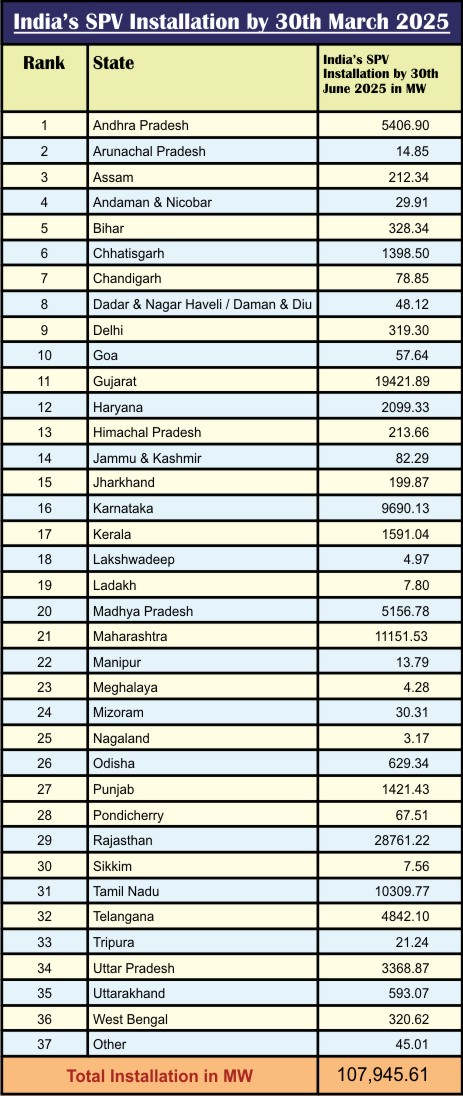
India has witnessed an unprecedented surge in solar energy generation over the past decade, driven by a combination of government initiatives, increasing corporate participation, and a growing global emphasis on sustainable energy sources. Solar photovoltaic (PV) systems form the backbone of the country's renewable energy roadmap, and their potential is typically assessed based on factors such as the availability of suitable land, quality of solar radiation, and connectivity to the grid. As of March 31, 2025, India's aggregate installed grid-connected solar capacity has reached an impressive 107.94 GW. This milestone highlights the nation's steady progression toward its renewable energy targets and its pivotal role in combating climate change through green energy deployment.

The following section provides an in-depth look at the top ten states in India ranked by installed solar energy capacity as of March 31, 2025, along with a comprehensive account of significant projects that have contributed to their current standing. The narrative also underscores how each state has capitalized on its geographical and industrial advantages to enhance renewable energy production.

#1. Rajasthan

At the forefront of India's solar energy revolution, Rajasthan has consolidated its position as the national leader with an installed grid-connected solar energy capacity of 28.76 GW as of June 30, 2025. This is a remarkable leap from approximately 22.41 GW recorded at the close of the previous fiscal year. The state's abundant sunshine, vast tracts of arid land, and proactive renewable energy policies have together enabled this remarkable expansion. Rajasthan's solar infrastructure serves as a benchmark for other regions aspiring to harness solar energy on a massive scale. Several landmark projects have fueled this growth.

One of the most significant additions came from ReNew Energy, which undertook an approximately 1 GW solar project as part of the Make in India initiative. Of this, 750 MW was commissioned in December 2024, and the balance 225 MW became operational by January 2025. This project drew attention not only for its scale but also for its integration of locally manufactured panels sourced from Jaipur and Dholera. ACME Solar also made headlines with the commissioning of a massive 1,483 MWp (1,023 MW AC) solar cluster in Jaisalmer in December 2024. Part of a 1.2 GW AC project, this development represented one of the largest single-location solar initiatives in India for the year. Adding to this momentum, Adani Green Energy commissioned a 250 MW plant at Bhimsar on March 20, 2025, thereby expanding its already extensive renewable portfolio.

Further, ACME Solar's 300 MW Sikar solar project in Bikaner reached full commissioning in June 2025, with its final 60 MW coming online on June 24. This plant operates under a 25-year power purchase agreement with SECI at a competitive tariff of INR 3.05/kWh and benefits from ISTS waiver incentives. Complementing these projects, NTPC completed the commissioning of its remaining 52 MW at the 245 MW Nokh Solar Project in June 2025, with the earlier 193 MW already operational in March 2025. Similarly, NHPC began injecting power into the grid from its 300 MW Bikaner solar PV project in March 2025, with 31 MW operational initially and the full commissioning scheduled by August 2025. Collectively, these initiatives underscore Rajasthan's exceptional capacity to lead India's solar energy landscape.

#2. Gujarat

Emerging as a formidable contender, Gujarat has ascended to the second position with an installed solar capacity of 19.42 GW as of June 30, 2025. This represents a significant jump from 14.35 GW a year earlier, reflecting the state's strategic emphasis on renewable energy. Gujarat's hybrid energy policies and its dedication to large-scale projects have ensured its position as a leading green energy hub.

A cornerstone of Gujarat's solar expansion is the Khavda Hybrid Renewable Energy Park, one of the largest of its kind in the world. Located near Vighakot in the Kutch district, this park aims for a total capacity of 30 GW by combining solar and wind power. Within this park, Adani Green Energy commissioned 1 GW of solar capacity in March 2024, setting a major milestone. Further expansions followed swiftly, with an additional 275 MW commissioned by AGEL's subsidiary in February 2025, supplementing a 250 MW project completed earlier. Meanwhile, NTPC Renewable Energy Ltd. has made notable contributions, commissioning 142.2 MW from its 300 MW Khavda Hybrid Tranche V project and 146.7 MW from its 1,255 MW Khavda-I PV project in June 2025. NTPC's 150 MW Gujarat Solar PV Project also achieved full commercial operation by May 2025, executed in phases beginning in mid-2024.

The Government of Gujarat has further supported this growth through GSECL's initiatives. On May 27, 2025, the Union Government inaugurated 266 MW of solar projects under GSECL, including 210 MW at Babarzar, Jamnagar, 11 MW at Jambudiya Vidi in Morbi, 10 MW at Manjal in Kutch, and 35 MW near Lakadiya in Kutch. The collaborative efforts between state-owned and private enterprises in Gujarat have created a model ecosystem for renewable energy development.

#3. Maharashtra

Ranked third, Maharashtra has demonstrated commendable progress in solar capacity, recording 11.15 GW of installed capacity as of March 31, 2025, compared to 6.59 GW in the previous fiscal year. The state's industrial prowess and substantial energy demands make it a vital player in India's green transition. Recent mega projects underscore Maharashtra's growing significance in the renewable sector.

The most prominent among these is the Chapalgaon Solar PV project. Its first phase of 145.99 MWp (100 MW AC) was commissioned on May 22, 2025, nearly 19 months ahead of its scheduled date. This milestone came just 2.5 months after signing the PPA with MSEDCL on March 7, 2025. The second phase, comprising 71 MWp, achieved commissioning on June 23, 2025, taking the total operational capacity to 217 MWp. This project is noteworthy not only for its scale but also for its remarkable completion timeline—almost 18 months ahead of schedule.

Other projects have also added to Maharashtra's solar footprint. Godrej & Boyce commissioned a 25 MW ground-mounted solar plant at Dhule in September 2024. Additionally, Juniper Green Energy developed a hybrid project in Wardha with a solar capacity of 59 MWp commissioned in June 2025. While smaller in comparison to Chapalgaon, these projects collectively contribute to Maharashtra's ambition of becoming a major energy hub.

#4. Tamil Nadu

Tamil Nadu, long known for its leadership in renewable energy, ranks fourth with 10.30 GW of installed solar capacity as of June 2025, up from 8.61 GW a year earlier. The state's supportive policies for industrial offtakers and its growing open-access market have been pivotal in driving solar deployment.

Among its recent mega projects, Cleantech Solar commissioned 80 MWp of open-access solar PV capacity in May 2025. This was part of a larger 275 MWp renewable energy park, marking Cleantech's fifth solar park in Tamil Nadu. Its clientele includes major industrial players such as First Solar (US), DCW (India), and Murugappa Morgan Thermal Ceramics. The project's commissioning strengthens Tamil Nadu's status as a hub for industrial and utility-scale solar power.

#5. Karnataka

With an installed capacity of 9.96 GW as of March 31, 2025, Karnataka occupies the fifth position. The state, already a pioneer in renewable energy integration, continues to witness steady growth, up from 8.81 GW a year earlier. Multiple projects have contributed to this increase, enhancing both its industrial and commercial power portfolios.

CleanMax commissioned a 69 MWp solar plant in April 2025 as part of a 92.1 MW hybrid supplying power to Cisco in Bengaluru. Hero Future Energies added 29 MWp at Chitradurga in December 2024 under an open-access arrangement, while ITC Ltd. commissioned a 9.45 MW offsite solar facility at Davanagere in October 2024. Though relatively smaller than projects in Rajasthan or Gujarat, these additions demonstrate Karnataka's diversified solar growth strategy.

#6. Andhra Pradesh

Ranking sixth with an installed solar capacity of 5.40 GW as of June 2025, Andhra Pradesh has recorded notable growth from 4.62 GW a year earlier. The state's upward trajectory is exemplified by a key mega project undertaken by Adani Green Energy. AGEL's subsidiary commissioned a 250 MW solar plant in Kadapa on March 8, 2025, with formal confirmation on March 11. This installation is part of the Kadapa Ultra Mega Solar Park, being developed by APSPCL in collaboration with SECI, APGENCO, and NREDCAP. The project underscores Andhra Pradesh's ability to attract large-scale investments despite challenges faced by the renewable sector in recent years.

#7. Madhya Pradesh

Madhya Pradesh has secured the seventh position with 5.15 GW of installed capacity as of June 2025, up from just over 4.07 GW in the prior year. The state has leveraged its water bodies and available land to expand both conventional and floating solar capacities. Noteworthy among its initiatives is the Omkareshwar floating solar project, which commissioned around 90 MW on the Omkareshwar Dam reservoir in August 2024. Tata Power Renewable Energy added another 126 MW floating solar facility at the same location, marking one of India's largest floating solar deployments.

Other major contributions include NTPC Renewable Energy's 105 MW Shajapur Solar Project, fully commissioned by March 13, 2025, and Powergrid's 85 MW solar PV plant at Nagda in Ujjain district. Together, these projects illustrate Madhya Pradesh's strategy of integrating innovative floating solutions with traditional ground-mounted projects.

#8. Telangana

Telangana, with its robust industrial base, ranks eighth with 4.84 GW of installed solar capacity by June 2025, marginally higher than 4.80 GW at the end of March 2024. Though its incremental growth has been modest compared to other states, Telangana holds strong potential for future expansion. The Singareni Collieries Company commissioned a 10.5 MW captive solar plant at Kothagudem in February 2024, increasing SCCL's cumulative solar capacity to 234.5 MW. Additionally, NLC India signed a PPA in August 2024 to develop a 200 MW solar power project expected to be commissioned by June 2025. While not all projects qualify as “mega” installations, they represent consistent industrial adoption of solar power.

#9. Uttar Pradesh

Uttar Pradesh ranks ninth with an installed capacity of nearly 3.36 GW by June 2025, up from approximately 3.06 GW at the end of March 2024. Bundelkhand, particularly Jhansi and Lalitpur, has become a hub for large-scale solar projects in the state. Amplus, a subsidiary of GentariSdnBhd, commissioned its 73.4 MWp Project Lakshmi open-access solar plant in Jhansi in May 2024. SunSource Energy contributed another 45 MWp across Jhansi and Lalitpur. Most notably, TUSCO's 600 MW solar plant in Jhansi was commissioned in January 2025, while Fourth Partner Energy's 100 MW plant at Babina, Jhansi began operations in mid-2024. These projects collectively underscore Uttar Pradesh's ambition to integrate renewable energy into its development agenda.

#10. Haryana

Finally, Haryana holds the tenth position with an installed solar capacity of 2.09 GW by June 2025, up from 1.62 GW as of March 2024. Though relatively smaller in scale compared to its peers, Haryana has been proactive in encouraging industrial players to embrace renewable energy. A significant contribution has come from Maruti Suzuki, which commissioned two projects totaling 30 MWp—20 MWp at Kharkhoda and 10 MWp at Manesar. These installations increased Maruti's cumulative solar capacity in Haryana from 49 MWp to 79 MWp. Haryana's focus on corporate-driven solar projects highlights its strategy of leveraging industrial growth to drive renewable energy adoption.

Softdisk projects an additional increase of approximately 25 GW in India's total installed solar capacity by March 2026, as several major projects are already commissioned post-March 2025 but are not reflected in the above chart.

SD EDITORIAL DESK

SD AWARDS
SD's SOLAR AWARDS 2025
SD's Top 3, Indian Rooftop Solutions Company of the year ending March 2024-2025
SD's Top 3, Indian Grid Sharing Solar Power Solution Provider of the year 2024-2025
SD's Top 3, Indian SPCU (Non String) Manufacturers of the year 2024-2025
SD's Top 3, Indian Hybrid Solar Power Solution Provider of the year 2024-2025
SD's Top 3, Indian Off Grid Solar Power Solution Provider of the year 2024-2025
SD's Top, Battery Energy Storage Solutions (BESS) Manufacturers of the year 2024 - 2025
SD's Editorial Choice Award of the year 2024 - 2025
SD's UPS AWARDS
SD Awards 2025
Survey Highlights
SD's Power Electronic Industry Analysis, year ending March 2025
SD's Top 10
Power Electronic Companies
SD's Top 10
Indian Power Electronic Companies
SD's Top 3
Online UPS Manufacturers
SD's Top 3
Line-Interactive UPS Manufacturers
SD's Top
Home UPS/CVT/Inverter Company
Special Awards
SD's UPS SURVEY
SD's UPS Users' Choice Awards 2025
Companies to Watch
SD Users' Satisfaction Rating